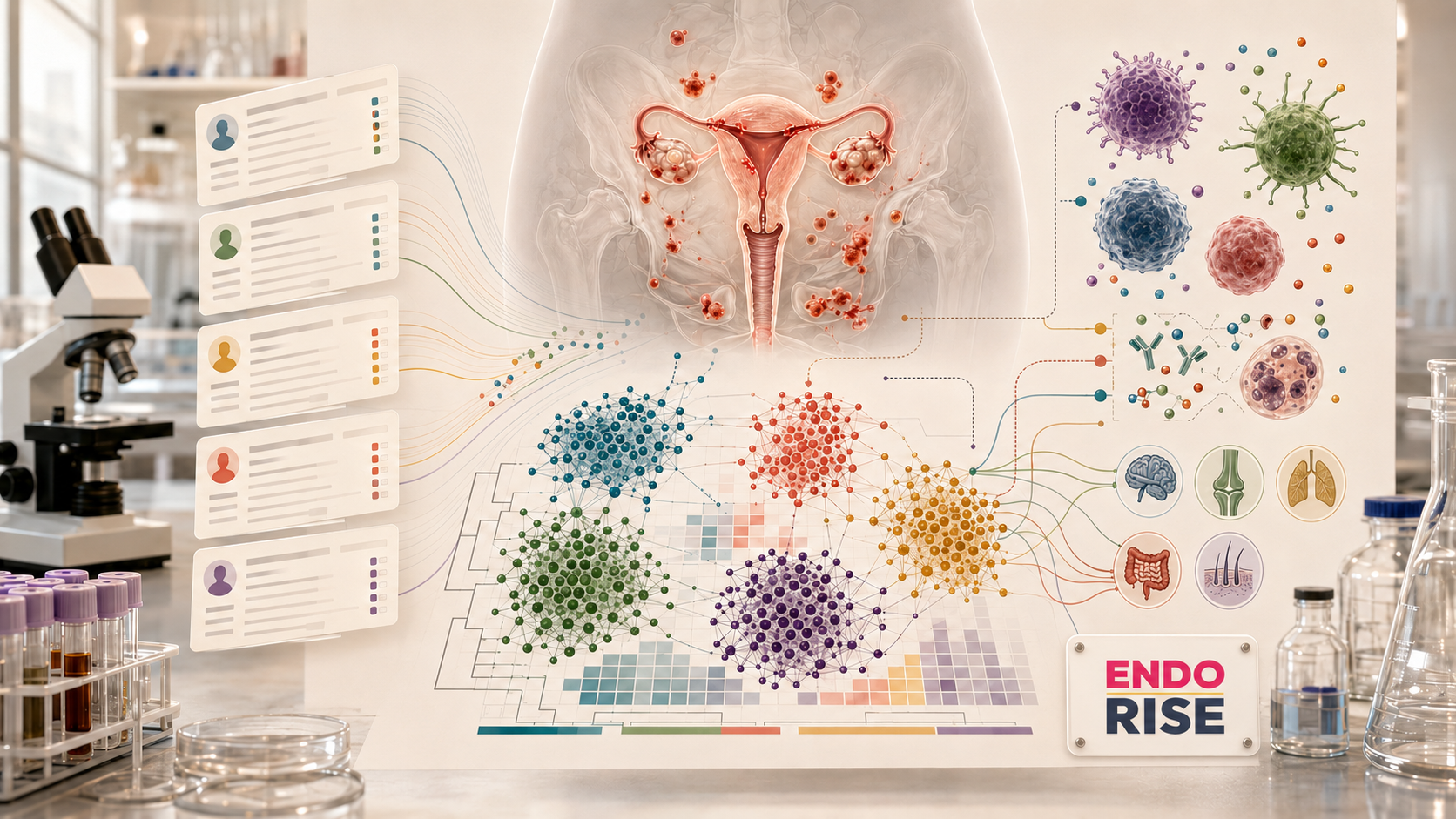
EndoRISE
ML pipeline for endometriosis research at The Jackson Laboratory
Story Behind the Project
I lived with endometriosis, PCOS, and adenomyosis for years before getting answers — the same years I was building ML systems professionally and earning my Masters in Computer Science. The gap between what I was capable of in my work and what I was being told about my own health was hard to ignore. It pushed me toward a question I couldn't let go of: how much of what women experience is simply not being measured, modeled, or taken seriously enough to show up in the research?
When the opportunity came to bring my ML expertise directly to endometriosis research at The Jackson Laboratory, it felt like the work I had been building toward without knowing it.
About
EndoRISE is a state-supported, multi-institution initiative dedicated to advancing endometriosis research, innovation, support, and education. Endometriosis affects over 200 million people globally and remains one of the most under-diagnosed and under-researched conditions in women's health. The program is co-led by Dr. Elise Courtois, Ph.D., a molecular biologist and senior research scientist at The Jackson Laboratory who directs the Single Cell Biology Lab, and Dr. Danielle Luciano, M.D., an Associate Professor of Obstetrics and Gynecology at UConn Health and fellowship-trained minimally invasive gynecologic surgeon.
At the core of the program is the CT Data and Biorepository — the first public, multi-institution endometriosis tissue and data repository — enabling research, clinical, and industry partnerships across Connecticut and beyond. Dr. Courtois's lab uses single-cell analysis, spatial genomics, and 3D cellular modeling to investigate how the disease microenvironment contributes to lesion development, recurrence, and systemic effects. I contribute ML infrastructure to this work, collaborating closely with the Courtois Single Cell Biology Lab at JAX.
My Role
I build and maintain the ML infrastructure supporting this research. My work spans patient stratification using clustering analysis on EPHect-standardized clinical data, association analysis between inflammation markers and immune comorbidities, and imaging and clinical phenotyping pipelines supporting discovery research across large patient cohorts.
Key Focus Areas
- Patient stratification using clustering analysis on EPHect-standardized clinical data
- Association analysis between inflammation markers and immune comorbidities
- Imaging and clinical phenotyping pipelines supporting discovery research across large patient cohorts
Impact
Research ongoing — impact and publications will be linked here as the work progresses.
Technologies
Links
Links to publications will be added as the research progresses.
Artifacts
Additional artifacts coming soon.