HealthSteward
Privacy-first agentic AI health coordination system
Story Behind the Project
Managing a chronic illness isn't just a medical challenge — it's a logistics one. I live with endometriosis, PCOS, adenomyosis, and several immune comorbidities, which means coordinating care across multiple specialists, tracking records from different systems, and walking into appointments without losing the thread of what was discussed three visits ago. Every tool I tried either ignored privacy, reduced my health to a checklist, or made me do the heavy lifting of connecting the dots myself.
I started building HealthSteward because nothing else existed that took both patient privacy and care complexity seriously at the same time.
About
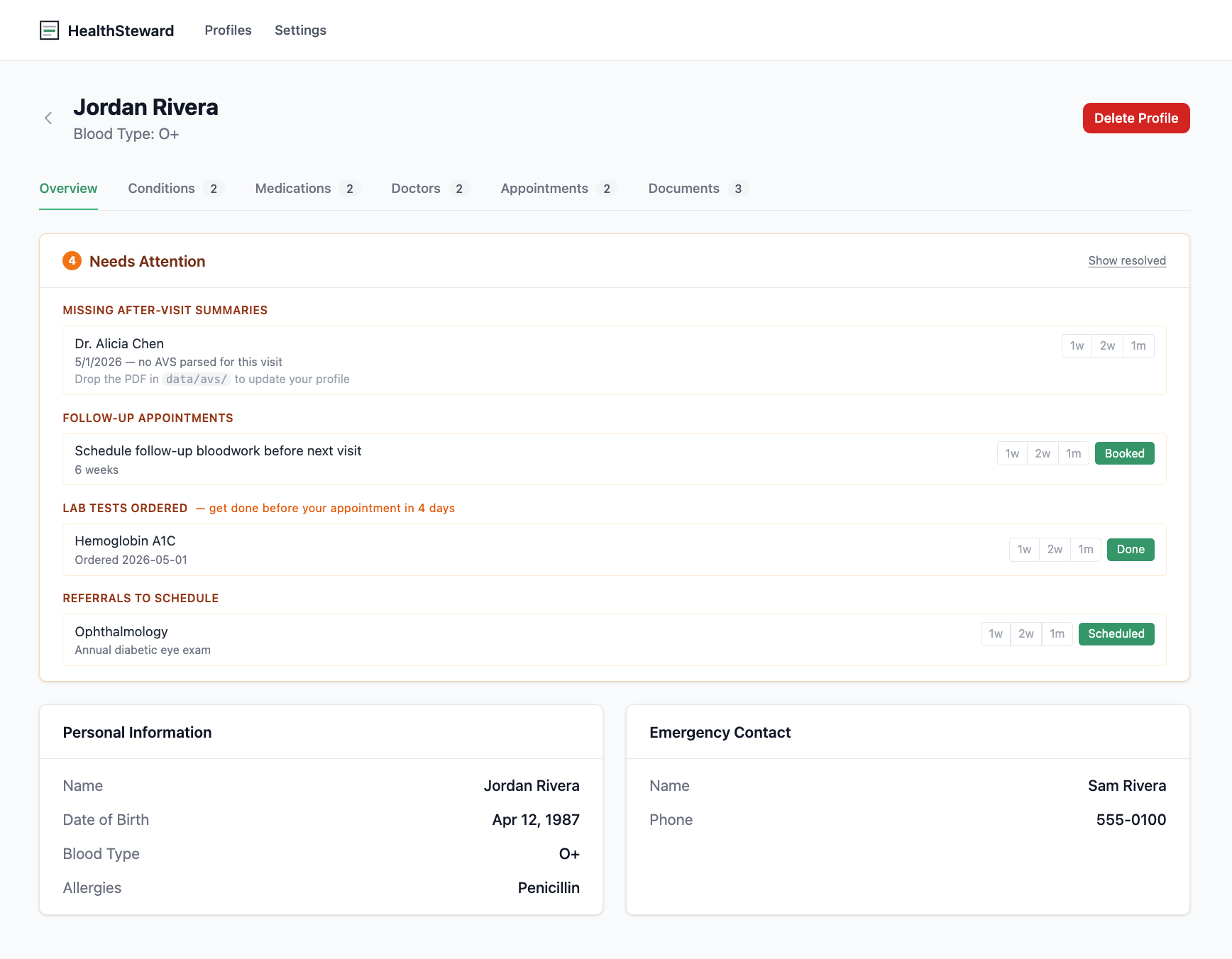
HealthSteward is a personal health coordination system that consolidates fragmented medical records across providers and conditions. It uses a local-first architecture — all sensitive processing stays on-device, and no health data is transmitted to external services unless explicitly anonymized first. The system is built to handle the kind of multi-condition, multi-provider complexity that most health tools aren't designed for.
My Role
Sole designer and developer, built in collaboration with Claude Code. This is a personal project — I defined the problem, designed the architecture, and built the full stack end to end, from the FastAPI backend and local LLM integration to the React frontend and PII anonymization pipeline.
Key Features
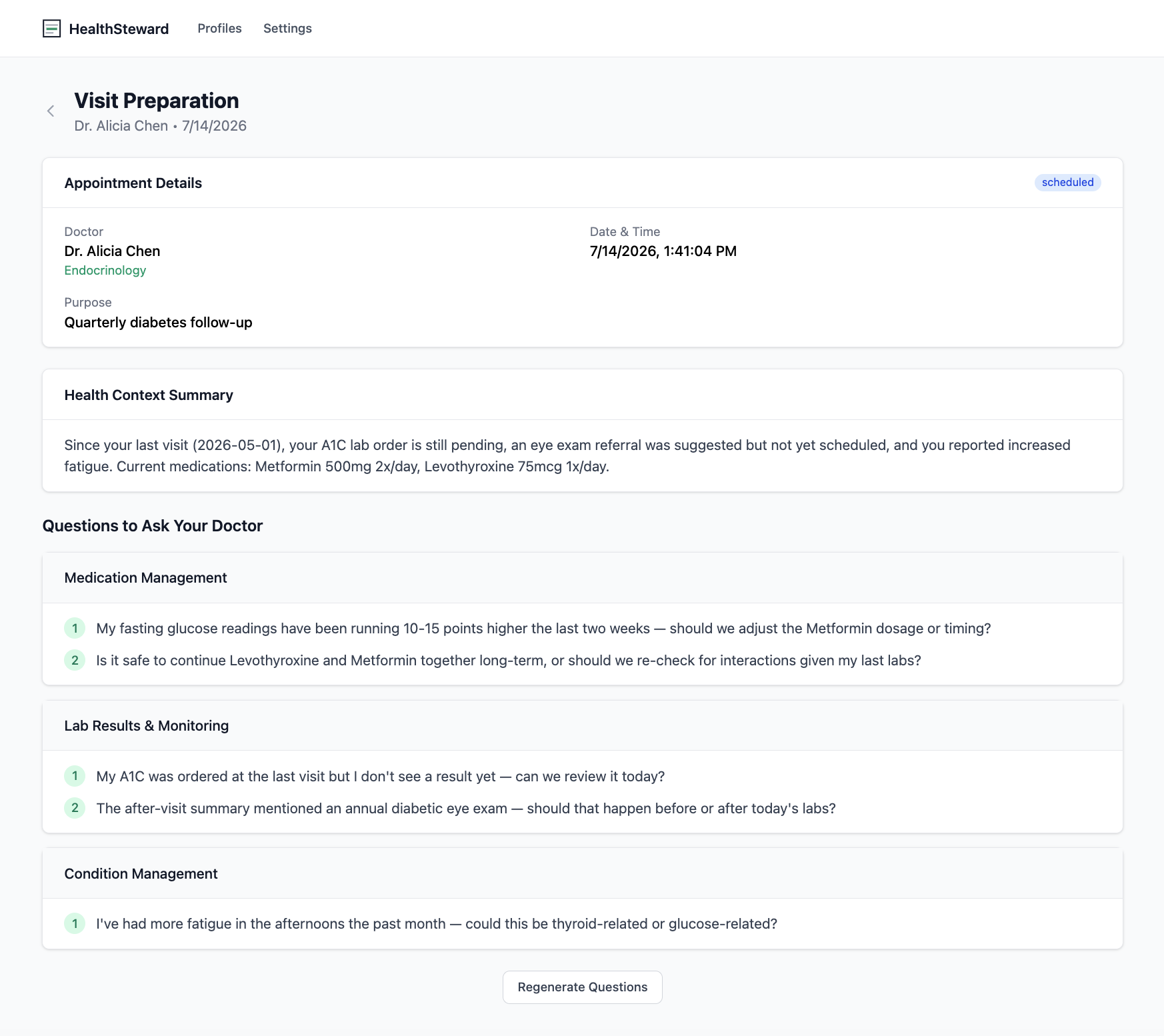
- AI-powered visit prep via an agentic tool-use loop — runs fully local on Ollama by default, with Claude API or any OpenAI-compatible provider as opt-ins; falls back to single-shot generation if the loop doesn't converge
- Local PDF parsing of after-visit summaries via Ollama with qwen2.5:7b, using targeted LLM calls only for unstructured sections — no cloud required
- PII anonymization layer for external LLM calls, combining deterministic field replacement, regex, and NER-based detection — no LLM involved in the anonymization itself
- Multi-provider record consolidation with condition and medication tracking
Impact
Still in active development — impact section coming once the core system is stable and in daily use.
Technologies
Artifacts
For a deeper look at the architecture, see the System Design section of the technical design doc — covering data flow, trust boundaries, the agentic fallback logic, and the PII anonymization pipeline.